
Chinese Demography
How Many Chinese Are There? How Many Will There Be?


The 2025 birth count for China in 2025 has been reported in many places, including all over X/Twitter. This paragraph is from the Japan Times:
China has just announced that births in 2025 plunged to 7.92 million, from 9.54 million the previous year — and almost half of what was projected (14.33 million) when the one-child policy was repealed in 2016. In fact, China’s births have fallen to a level comparable to that of 1738, when the country’s total population was only about 150 million.
This puts Chinese fertility at 0.99 just below one child per woman. I’m sure you know that you need 2.1 children per woman for a stable population. This is lower even than the famously low-fertility Japanese at 1.2, although higher than South Korea at 0.68 and falling (and even lower in Seoul at around 0.55). Of course, as with all statistics out of China, you have to assume political manipulation. But even without, these numbers are pretty devastating (same as 1738) so likely the actual number is even worse. Even the official numbers are a drop of 17% in just one year.
Estimates vary of how many Chinese there will be on a date in the future. If you pick 2050, it doesn’t depend much on the fertility rate since almost all the women who will give birth before 2050 have already been born. If you pick a date further out like 2080 then it depends critically on whether you assume the fertility rate remains around 1 or if you assume it will continue to slowly decline as it has in South Korea. Or, as the WHO does with zero information, it will go back up.
Of course, the population doesn’t just depend on the number of babies being born, but also how many people are dying. In first few decades of Maoist China, medicine improved a lot and life expectancy went up. But that was a one-time thing, you can only go from life expectancy going from sixtyish to eightyish once. But, assuming we don’t get some breakthrough where everyone becomes essentially immortal, then a slow incremental increase is likely. It really doesn’t make much difference to the overall population if life expectancy is 82 or 83, there are just not that many 82-year-olds.
How Many Workers?
Even the Chinese admit that the working-age population has been declining for a few years, and since nobody trusts Chinese data, everyone assumes it has been declining for much longer. Despite this, there are no jobs for many young people. Just how bad it is is up for debate. The Asia Society Policy Institute says:
China’s urban youth unemployment rate for ages 16 to 24 has hovered around 20% since the pandemic. When it reached a record 21.3% in mid-2023, the National Bureau of Statistics stopped publishing it. When reporting resumed a few months later, figures were calculated using a new methodology that corrected downward. But even with the new system, youth unemployment stood at 16.9% in February 2025…many believe the true figure to be much higher.
And don’t forget that a person with a master’s degree in microbiology working at Starbucks (or more likely Luckin Coffee) counts as employed (a problem that most countries have, not just China).
1.4 Billion?
Estimates of future population depend a lot on what the current population of China is. The official number is 1.4 billion, but I have seen many analyses that it is lower and perhaps a lot lower. Indeed, there are whole books on the topic (of which I confess I have only read a few extracts) such as:

Another wrinkle is that whatever number you believe for the population, the number of women is less than half that due to a preference for sons. If you think about it, that means that fewer children will be born, but on the other hand it actually pushes the fertility rate up since the same number of babies is spread around fewer women (men don’t get counted in fertility calculations, the rate is always calculated per woman).
A lot of estimates of the current population start from the generally accepted number of 540 million Chinese people in 1949. The modern Chinese state, the PRC, was founded on 1st October 1949. Of course, given the size of China, the fact that it had just gone through a civil war, and the country was mostly rural with poor recordkeeping, there are probably large error bars on this number. But let’s take that 540 million number as given, meaning about 250 million women in 1949.
What is the evidence that the population today is 1.4 billion? The only source is the Chinese government itself, and a lot of those numbers come from aggregating statistics from the various regions, all of whom have a big incentive to pad the number to get increased financial support from Beijing. The fertility rates need to be insanely high for nearly 80 years. This covers a period with the Great Leap Forward where 35-50 million people are estimated to have starved to death. Also the cultural revolution, which is estimated to have killed about 2 million.
The one-child policy existed from 1979 until recently. Official numbers are that the population grew during this period from 1.1 billion to 1.4 billion, but that the official fertility rate was 1.5 (you need 2.1, remember, to just stay flat). This is perhaps mathematically possible if lifespan increases fast so that deaths are always less than births despite the one-child policy, but this just seems implausible. If you walk around in China you will often see four grandparents with their single grandchild, that’s what a fertility rate of 1 means.
China is also estimated to have lost large numbers of people to Covid. The official numbers are simply not believable.
Here’s an interesting video, How I Used AI to Calculate China’s Real Population. The conclusion is that China’s population is less than a billion and maybe as little as 700 million. The video is only 12 minutes long so definitely worth a watch.
GDP
Everyone believes China’s GDP is overstated. Indeed, former Chinese Premier Li Keqiang didn’t even believe them and invented his own index based on electricity usage, rail freight, and bank loans. This is now semi-officially known as the Li Keqiang Index. As the service component of the economy grows (and physical goods such as real estate contract) this is probably less accurate—you don’t need a railcar to move a program, although with AI it does appear you need a lot of electricity. But the Li Keqiang index is much lower than the official numbers, which was obviously his motivation to develop it in the first place.
If you like your explanations in video form, then be my guest:
Born in the USA
I was writing this post when I receive an email notification of a substack piece by demographer Lyman Stone How I Stopped Worrying And Learned To Love Fertility Polarization.
Of course, the fertility rate in the US is also below replacement, but the US has high immigration (including me) which fills the gap. But what I hadn’t realized was the huge difference between the fertility rate of Democrats and Republicans, as measured at the county level of granularity. And not just the huge difference, but how fast it is widening.
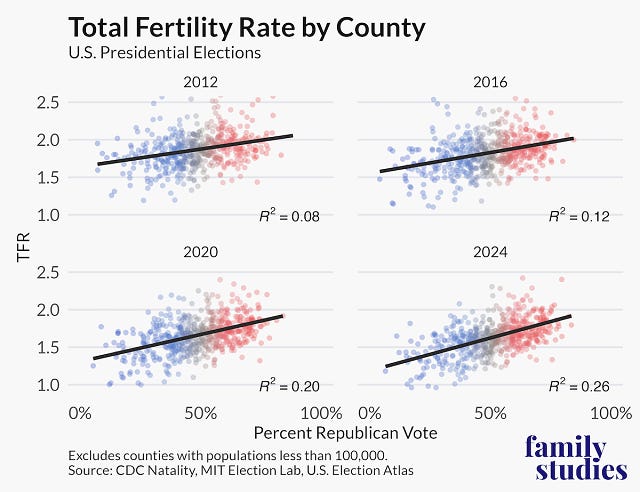
The peak-red counties had ~2 kids/woman in 2012, 2016, 2020, and 2024. But the peak-”blue” counties had ~1.7 in 2012, ~1.6 in 2016, ~1.4 in 2023, and ~1.3 in 2024. The blue-er the county, the more fertility has fallen in the last decade or two.
So the most Republican counties have kept steady at close to replacement level for the last 15 years, whereas the birthrate in the most democratic counties has fallen every year recently and is down to 1.3 (for 2024, there is no 2025 data available yet). It is unclear which way causality runs, if at all: do women who don’t want kids gravitate to blue counties (such as San Francisco), or do women who live in blue counties become childless because of a sort of contagion, like how so many teenagers and young women became anorexic a few decades ago.
I have no idea what effect this has on long-term electoral prospects, especially as the data on the political alignment of kids is murky: the kids of Republicans are not reliably going to be Republicans themselves.
Happy Chinese New Year
新年快乐 Happy New Year. It is the year of the horse. Since my birthday is a multiple of 12 this year, that means I am a horse (born in a year of the horse).
I though that might be good, so I googled it. Oops. Apparently:
A year that matches your Chinese zodiac sign (known as Ben Ming Nian) is traditionally considered a year of bad luck or "strictness" rather than a lucky one, as it marks a 12-year cycle where you clash with the god of age, Tai Sui. It is believed you are under higher scrutiny, requiring you to wear red, avoid major life changes, and stay humble to avoid "slip-ups".
As it happens, completely coincidentally, I am wearing a red shirt as I type.
Fascinating analysis, both for China and the US. Thanks.